Tuesday, February 9, 2010

Cat-lit


Beaker, posing to the right with her maladjusted pet human, spends Sunday afternoons sitting back with the latest issue of Event.


Meanwhile, George, left, is functionally illiterate and wishes he could read like his sister.


[Read "Eat Fist!," a story I wrote, in the latest issue of Event]

Monday, February 8, 2010

Old Interview

This little number appeared on a Xenith last year. I was really flattered, since I'm not really all that published whatsoever, but the thought was nice and the questions fun and so here it is, in all its . . . whatever it has.

--


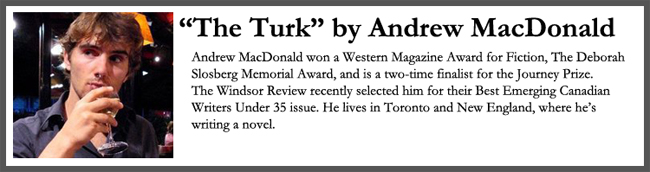
Given the numerous magazines in which this particular gentleman has been published, Xenith readers may have already stumbled across Andrew MacDonald’s short fiction. At 24, Andrew is working on his masters in creative writing and has been published in The Fiddlehead, Blackheart Magazine, Existere, qwerty, Feathertale, echolocation, and many other magazines. He also maintains a blog at caughtwithstring.blogspot.com. In this interview, he touches on the writing and revision process as well as his experience with publishing in the small press.

Interview by Patrick Nathan

As someone who has primarily published fiction, you’ve developed an undeniable skill for it. When you contrast your writing now versus your writing from when you first started out, what is the most marked difference? What, if anything, has remained the same?

That’s a good question. When I first started out, I didn’t pay much attention to plot logistics. I focused a lot more on style, mostly of the high fallutin’ kind. Lots of big words, lengthy descriptions, tons of exposition. Nowadays I’m more interested in crafting stories, not sentences. An old mentor once told me that writers tend to be stylists or storytellers. I used to classify myself as the former; now, not so much.

The more I write, the more I realize that language will always service the idea. That sounds complicated, but it’s not. Your goal is to entertain, or otherwise engage, your reader. An alienating text is rarely successful. Or at least I avoid them like the plague. Everyone denigrates the Dan Browns, the JK Rowlings, the Grishams. Not me. I admire their mastery of storytelling craft. We like to think that writing is all about beautiful words. Maybe that’s part of it, and certainly it’s one of the first things I worked on when I started. But the art of crafting a plot is a huge part of writing fiction, and lately that’s the part of the game I’ve been focusing on. Someone like John Irving is a good example of a, quote, literary writer, who pays attention to plot, makes things happen, and doesn’t have a really graceful style. I think of Dickens too, or Graham Greene (though some people might disagree about him).

Other than that, developing discipline and shedding the title of weekend writer. You have to take your writing seriously if you want other people to.

Almost everyone has some definable method of organizing thoughts and ideas in preparation for writing. What is the typical series of events that takes place between the initial spark of your short story and writing the first sentence?

I like to have a vague idea of where I’m going, but I’m open to change. Usually something hits me, a sentence, an idea, some weird event, and I’ll try to work through the possibilities. Once I have something, anything, I’ll write a few sentences. Most of the time they’re not in any kind of coherent order, at least on the page, but in my brain they fit like jigsaw pieces in a bigger picture. The less time I spend being anal and planning the better. The less restraint, the better. The less time I spend analyzing what goes into that first draft, the better.

So when you tell someone that you’re working on a story, and they ask you what it’s about, it’s pretty safe to assume that you aren’t sure yet? In that vein, when someone asks the same question on a finished story, are you able to answer?

Sure. For me, the summary is really about isolating the story’s conflict. You hear agents throw around this piece of advice all the time for novels, and I think it applies to fiction of all flavors: if you can’t summarize your story in a sentence or less, you might need to do some thinking. Going into a story I’ll probably have a good idea about what it’s going to be a about. At least generally. It could change as circumstance dictates.

How would you describe your revision process? What do your first drafts generally look like in comparison to the copy that goes to the publisher?


Revision’s more fun that writing the first draft. Still painful, though. Sometimes my first drafts are pretty solid, but mostly they’re awful, putrid, stenchy.

Let’s throw in a quote by Charles de Gaulle: “Don’t ask me who’s influenced me. A lion is made up of the lambs he’s digested, and I’ve been reading all my life.” What lambs have you digested? Who shows up in what way?

That was eloquently phrased. Well done, Chuck. Immediate influences? Salman Rushdie, Mordecai Richler, John Irving, Zadie Smith. Recent digestifs include Shalom Auslander’s Foreskin’s Lament, Katherine Dunn’s Geek Love, Bechdel’s amazing graphic novel Fun Home, and The Brief Wondrous Life of Oscar Wao by Junot Diaz.

Conversely, what lambs have given you indigestion?


This will get me chirps from both ends of the litgeek spectrum, but Chuck Palahniuk and Jane Austen. I think Chuck’s got a good marketing team and a bagful of gimmicks he employs every book. I enjoyed Fight Club. Anything after that . . . he just gets worse and worse. Sigh. Plain Jane’s got skills I respect, she’s just not my thing.

There’s no getting around the fact that you have an impressive list of publication credits. What is your usual process for submitting a piece of writing? Do you let it sit for a few months, awaiting revisions, or do you submit immediately after finishing? Do you submit to several magazines at once or just pick what you think would be a good fit? Do you write pieces and think, “Hey this would be a good fit for Fred’s Magazine” or do you come to that decision much later?


I used to be impatient, sending everything out the second I lifted my fingers off the keyboard. Which meant I’d have ten pieces floating in submission land, and ten rejections coming a few months later. While that didn’t yield particularly stunning results, it was an important step: send your stuff out there. Be too big for your britches. Grow thick skin and get used to the process.

Getting work out there, published in journals, is rough: the pay is crap, the wait is long, and most people don’t care. On the other hand, it’s a good way to build your CV and your confidence. And who knows who might be reading? An agent caught the story a friend of mine wrote in a nationally distributed literary journal and asked if he had representation yet. I don’t send stories out anymore unless I’m confident in them, and even then I expect a rejection letter. What used to be a week of editing a story has turned into months. Having one really sharp story is probably worth more than a handful of clunky ones. I’ve done some small-time journal editing and know from experience that editors are looking for reasons to trash your stuff.

I tend to avoid writing for specific markets, partly because I get caught up in writing what I want to, for better or for worse, and partly because I just plain suck when I try. Most of the places I submit to frown upon simultaneous submissions, so it makes for long waits. Duotrope is a fantastic resource and I use it every time I submit to a publication.

What would you say is cardinal advice for authors looking to start submitting their work?

Cardinal advice? Just do it. Follow the guidelines and get work out there.

If you could boil it down to something specific, what is the most important lesson you have learned in the years you’ve spent improving your craft?

Keep going when everyone else quits.


07/06/09

New Review


Pick up the latest ish of Broken Pencil and peep my review of Playing Basra, Edward Brown's collection of interwoven short stories about people and things pertaining to the lower middle class. I compare it to Trailer Park Boys! Gazooks!

Saturday, February 6, 2010

Cyrus

Discerning readers would be well advised to read the latest from the Heartbreak Kid, Spencer Gordon, up at Joyland this week. It's a short story about Miley Cyrus and should be read in a Southern accent for maximum a/effect.

Tuesday, January 19, 2010

Journey Prize

Just got the good word that my story, "Eat Fist!," due out in Event next month or so, has been nominated for the Journey Prize. Time for celebratory something or other.

If something comes of this, I'll let you know.

Friday, January 8, 2010

Dinosaur Porn Launch

Attend on Facebook! http://www.facebook.com/group.php?gid=2240060756#/event.php?eid=234790465901&ref=mf

Thursday January 28th, 2010
7:30 - 10:30 PM
The Supermarket (268 Augusta Avenue, Toronto, ON)
No Cover

A LAUNCH PARTY SIXTY-FIVE MILLION YEARS IN THE MAKING.

Well, more like six months, but hey - thanks for your patience.

DINOSAUR PORN has been lovingly edited and designed by the DIY dream team combination of Ferno House and The Emergency Response Unit. This is a limited-edition, lovingly handcrafted, and perfect bound collection of poetry and fiction.

DINOSAUR PORN features the prehistoric poetry and/or fleshy fiction of Louise Bak, Gary Barwin, David Brock, Andrew Faulkner, Warren Dean Fulton, Spencer Gordon, Corrigan Hammond, Joe Hickey, Penn Kemp, Henry Lee, Christine McNair, Dave Miller, Nathaniel G. Moore, James Nadel, Leigh Nash, Kenneth Pobo, Shannon Rayne, Carey Toane, Jordan Trethewey, and Sarah Wilson.

So join us for a night of merryment, and come pick up this weighty tome for a mere $15. Other chapbooks released by Ferno House and The Emergency Response Unit will be availble for sale, as well.

To help us hatch this behemoth, we've invited some contributors to come and read their work. Come see readings by:Louise Bak, Gary Barwin, David Brock, David Miller, Nathaniel G. Moore, Christine McNair, and Carey Toane.

Louise Bak is the author of Tulpa, Gingko Kitchen and emeighty. She’s gained widespread attention as the co-host of Sex City, Toronto's only radio show focused on intersections between sexuality and culture on ciut 89.5 fm. She is a sexual, cultural columnist with toro. Her performance work has appeared in numerous galleries, festivals and video collaborations, including Broadcast, Partial Selves, and Crimes of the Heart. She also hosts a salon series called The Box, which encourages communication across creative borders. She wrote a feature called The Ache, which is currently in development. She is also working on another collection of poems.

Gary Barwin is responsible for such body part innovations as fur, feathers, claws, differentiated teeth, water-impervious skin, water-impervious eggs, and the penis. Stress fractures in some of Barwin’s vertebrae may have been caused by the weight load of copulation. Barwin once was reconstructed so that his head was placed at the end of his tail instead of its rightful place on his neck. The largest of Barwin’s eggs ever discovered had a liquid capacity of almost 6 litres. He has the longest skull of any land-living poet—it is 9 feet long. Barwin’s vertebrae suggest that he may be 120 feet long. Gary Barwin always walks on his toes (for more see serrifofnottingham.blogspot.com).

David Brock is a playwright with a zoology degree. Recent work has appeared in Event, Eye Weekly, Poetry is Dead, and Quills Canadian Poetry Magazine. He is currently writing a Spring/Summer line of fashion poetry for a literary collaboration with Vancouver-writer Sean Horlor, libretti for two new operas, and a collection of Saved by the Bell essays. A chapbook of poetry is forthcoming from The Emergency Response Unit in the fall of 2009.

Christine McNair has been published in The Antigonish Review, Misunderstandings, fireweed, Prairie Fire, ottawater, the Bywords Quarterly Journal and a few other places. She's akin to wives-in-watercolours and badlands field jackets. She works as a book doctor in Ottawa.

Dave Miller has had work published in several places including The Malahat Review and The Fiddlehead. He's gone to a few universities including the University of Guelph where he's finishing his MFA. He's lived here and there and a few places in between, and is currently enjoying Toronto. He previously had very little experience with either porn or dinosaurs.

Nathaniel G. Moore is the author of Pastels Are Pretty Much The Polar Opposite of Chalk and other books like Bowlbrawl. He is an editor at Broken Pencil and a fan of Bam-Bam.

Carey Toane is a Toronto-based journalist, poet and host of the reading series Pivot at the Press Club. In 2009 she was grants coordinator of the Scream Literary Festival. Her poems have been published in CV2, This Magazine and Peter O' Toole, while her chapbook Ministry of the Environment was released in 2008 on Bench Press. Current projects include editing her grandmother's journals and investigating the social histories of domesticated plants and animals. Her favourite apple is the Westfield Seek-No-Further.

Hosted by the editors, Spencer Gordon, Leigh Nash, Andrew Faulkner, and Arnaud Brassard. Hope to see you there! No cover! 7:30 PM!

http://theemergencyresponseunit.wordpress.com/
http://www.fernohouse.com/

Saturday, January 2, 2010

The Puritan Returns.

Back by marginal demand! The Puritan returns!

After sixteen months of dormancy, The Puritan is back with a brand-spanking new, twenty-first century online format, now publishing poetry, reviews, interviews, recipes, as well as prose.

Thank you to all our friends and supporters for sticking with us throughout our prolonged hiatus. Even if you haven’t been thinking of us in sixteen months, we’ve certainly been thinking of you.

Our new online issue – #8, Fall 2009 – features work by Angela Hibbs, Nathaniel G. Moore, Andrew Faulkner, Catriona Wright, Mike Spry, Pearl Pirie, Monty Reid, John Goldbach, Eva Moran, Michael Bryson, John Lavery, Sarah Dearing, Michael Blouin, Rebecca Rosenblum, and never-before-seen interviews with Sheila Heti and Jan Zwicky.

In typical fashion, we plan to release our next issue at the end of the season it claims to represent. So, we’re opening our pod-bay doors to submissions of fiction, poetry, reviews, recipes, and interviews. Check out our website’s submission guidelines for more information. The address is the same as it ever was – www.puritan-magazine.com.

Also, we’re open to the idea of considering your artwork for upcoming covers. Potential covers should reflect the general visual theme of our current issue’s cover and our wonderful website.

To help us pay down our monstrous debt, we’re opening our archives to you. That’s right – we’re selling our back issues at rock bottom prices. E-mail us for more details at puritanmagazine@gmail.com. Veteran and senior discounts available.

We won’t bore you any longer. Our new site hopefully says it all. Please visit often, as changes will be frequent and intriguing.

With love,

The Editors
Spencer Gordon
Tyler Willis

Publicity
Andrew MacDonald

Web Crew
Derek McCrone
Jamie Weir

www.puritan-magazine.com

puritanmagazine@gmail.com