Come celebrate the launch of Katie Jordon's debut chapbook with Frog Hollow Press, Commentary on a Non-Existent Self-Portrait. Cover art and illustrations by Hayden Menzies. The evening will be hosted by The Peacok at 365 King West (basement). Doors at 7:30pm. Readings by Claire Caldwell, Andrew MacDonald, Sarah Pinder and Katie Jordon at 8:30pm. Limited copies will be available for purchase. They can also be ordered through the press. http://www.froghollowpress.com/catalogue.html#Commentary Free snacks and $4.50 bar rail. Hope to see you there!I don`t like readings all that much, but every so often I say yes and do them. So. Get it while it`s hot. It being listening to me read something.

Friday, August 10, 2012
Reading: FHP Launch Party
I'll be doing a reading this Monday at The Peacock, where my friend Katie Jordan will be launching her debut collection of poetry. Rumour has it I'll be the only fiction reader there.
Anyway, the details live on facebook:
FHP Launch Party: Commentary on a Non-Existent Self-Portrait
Deets:

Tuesday, June 12, 2012
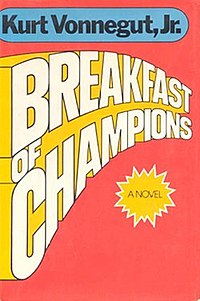
In which I reread Breakfast of Champions and think about it
The other day I decided I would go back and read some of my favourite books. I don't reread books very often; sometimes I just reread passages, so I can copy a particular style or get inspired. With whole books, though, I'm more interested in reading something new, so can learn something new. A conversation on television got me thinking: if I read a book that I enjoyed when I was younger, would I still enjoy it right now?
The conversation on television was about Kurt Vonnegut Jr. One half of the conversation, someone a few years older than me, said that Kurt Vonnegut is a young man's writer. "You can only possibly like him when you're young. There's a certain point after that where he seems juvenile. You can still enjoy him, but in a nostalgic kind of way." The other half of the conversation didn't add much.
I read a lot of Vonnegut growing up, even before I started writing. I wondered if the man on television was right. I started rereading Breakfast of Champions to find out.
The book is about Vonnegut's sci-fi writer Kilgore Trout and Dwayne Hoover, a rich man who believes he's a machine. Hoover reads a book by Kilgore Trout and goes nuts. The book's narrator is also a character in the story; in fact, the book's narrator has actually invented all the characters in the book and the books circumstances, only his control is vague and incomplete.
The novel is filled with little sketches and Vonnegut's trademark language. It sounds like it's written for someone who hasn't done a lot of reading.
Anyway, I should say that I don't go much for the postmodern stuff, especially these days. I don't like experimentation all that much, either. With the caveat that I know I'm making a broad generalization, it seems to me that a lot of experimental writing is written by a lot of lazy writers who denigrate things they secretly know they can't do well, like telling a story people want to read.
There are obviously exceptions to that. Breakfast of Champions is an exception. Somehow, I like it just as much as I had eight years ago, when I first read it. A good piece of art lingers, and I have a feeling that BOC is going to linger with me even more now that I understand how slyly complicated it is.
It's about death, and about the absurdity of life, a subject it shares with three other novels that I really like and will probably reread (Catch-22, The World According to Garp, and One Flew Over the Cuckoo's Nest. The thing about Vonnegut's best writing is that his unconventional form never overshadows the base humanity of his characters.
Maybe I'm being too hard on experimental writing. Nicole Krauss's The History of Love, to use a contemporary example, has been called experimental. I would argue that Krauss shares with Vonnegut a concern with human beings, with breaking their hearts. And Breakfast of Champions is heartbreaking, in its own way. It makes me think about bad things that have happened to me and the people that I love, in a way that makes me laugh and be okay with laughing. I think that's a rare thing.
Sunday, May 6, 2012
Many Things
It's been too long, I think. But I always say that. What have I been up to? Working a lot on this novel, which is the last I'll say about that, plus stories, plus, you know, what I do in real life, which is teach high school and freelance as a content development consultant. That's a real thing that's close to technical writing.
There, see? We've been dating for so long that I thought it was time for you to get to know me a little better.
Since I usually only post here when I have news about my writing, I guess I'll have to share news about my writing. First, and sadly, Other Voices, the Alberta-based journal who accepted my story about old people, is closing its doors FOREVER, which means my poor story has no home. If you want to buy it from me, I can sell it to you. I think you'll like it, but then, it's tough to account for taste. I'm not sure I have good taste, either.
Anyway. News number two is that The Windsor Review, who I never thought would publish me because Alistair Macleod was their fiction editor and I think he would really hate what I write, has picked up a short story of mine for their Best Under 35 issue. That sounds really impressive, right? Then, when you think about it, what it actually means is that they cut the submission pool drastically. Still. Sounds nice.
 The story is called "Blindspots" and it's about a relationship between two people trying to have a baby, and the man has no functional sperm, so they need to go the way of artificial insemination. So good stuff. I should also mention that Spencer Gordon has some poems in it, even though he didn't mention I was in the issue too on his blog. He's great and I'm happy to be in there with him. Poet Mat Laport is also in it, but he doesn't have a web presence so I can't link you to him. He's also good. There's going to be a video of us reading eventually, so you'll be able to see me move and talk and be animate, instead of the faceless presence I am on this blog.
Good! Good. Oh, and the latest issue of Riddle Fence is out and has a story of mine in it.
Double-Oh is that I read the most recent volume of The Journey Prize Stories. They selected one of my stories awhile ago for their 22nd incarnation, and it was / is / remains an incredible honor. Anyway, in number 23, you should read two stories: Seyward Goodhand's "Fur Trader's Daughter," which only lives in print, and Michelle Winters' story "Toupee." It lives online here.
Okay, that's all, that's it for now. Back to writing financial education manuals for me.
xo

Friday, January 27, 2012
Riddle Me This

Well hello there. Some little bits of news to report. First, old standby "Eat Fist!", a well-travelled short story that originally appeared in Event, has been scooped up by the Body Electric anthology, put out by and/or Publishing. Nifty! More recently, Riddle Fence, a great great journal from out east, scooped up my short story, "Up, Away, Here, Gone," for their March 2012 issue. How do I know RF is great? They published Andrew Sullivan's slick short story, "Stray Dogs." So. Good stuff.
Not good? I missed my flight to Tampa today by not showing up early enough, and by having a disgusting passport. I had to switch my flight to an 8pm (later delayed to 10pm) shitshow to Orlando. My ride back to Tampa probably wants me dead. So does my bank account. The switch cost me $230 extra.
On the brightside, I wrote 5,000 words as punishment. And watched four episodes of Jersey Shore (spoiler: Vinny peaces out). Oh, and I started reading John Irving's new novel about a bisexual dude! I scammed an ARC. I sort of wish he would stop writing about sex with older women and characters who are writers.
Anyway. I'll be dressing like a pirate this weekend, as per Tampa's pirate festival. Good day.
Sunday, November 27, 2011
Hodge Podge, plus Divinity Gene review
S'looking like I'll have an essay in an upcoming anthology of writers writing about their mentors called A Manner of Being: Writers on Their Mentors. Unsure if it's official or not, but I'm excited and wanted to share my excitement on my blog, which is this place. My essay is about how mentoring someone is like figuring out the best way to get someone off. I think it makes sense, and sounds less pervy, in context.
Anyway.
On a completely unrelated note, Diane Arbus is creepy. I'm reading about her in this book:

She's weird and her pictures make me feel bad about myself and the world, kind of like Radiohead. In any case, I have her pictures taped to the wall above my writing desk.

This thing below is one half of a review I wrote for MTLS, where I look at two short story collections. You can find the entire review here.
The Divinity Gene
by Matthew J. Trafford
Vancouver, BC: Douglas & McIntyre, 2011
192 pp. $22.95
Distillery Songs
by Mike Spry
London, ON: Insomniac Press, 2011
160 pp. $19.95
In her stint as guest-judge for The Giller Prize, British writer Victoria Glendinning railed against Canadian literature for being too boring, too regional, too . . . Canadian. In her eyes, we Canucks lack imagination, a willingness to take risks. See, for example, this excerpt from a piece in The Globe:
It seems in Canada that you only have to write a novel to get grants from the Canada Council for the Arts and from your provincial Arts Council, who are also thanked. Complaints were once voiced that most shortlisted Giller novels emanated from just three big-name publishers, all owned by Bertelsmann, and that virtually every winner lived in the Toronto area. Now, many of the submitted authors, and their rugged subject matter, hail from Saskatchewan, Manitoba, Nova Scotia, Newfoundland. That’s maybe because small publishers too are now subsidised, and they proliferate. If you want to get your novel published, be Canadian.
Though one can concede that maybe, just maybe, Ms. Glendinning has a point, it’s also clear she hasn’t read Matthew J. Trafford or Mike Spry. The Divinity Gene, Trafford’s debut collection, is a wicked fusion of Italo Calvino and the kind of funky grist you’d find in McSweeney’s, while Spry’s own debut collection, Distillery Songs, is a welcome knee to the groin of anyone who says that Canadian’s can’t be funny, subversive, or over-the-top.
The stories in The Divinity Gene tend to go one of two ways. Either they’re intensely creative pieces – a dance club run by angels demands of its patrons an odd sort of bartering, the son of a fisherman watches as dad slices open a mermaid – that challenge perception, or more conventionally realist stories where character trumps concept.
While the cover blurbs praise The Divinity Gene’s imagination, this reader found the glitzier pieces at times lacking. Take iFaust, for example. Here a new app for iPhones lets its users sell their souls for material ends. Once our justly-warped minds regain their natural shape, we start to consider the lives in the story. The problem, I suspect, has to do with length, lay-out, and what Trafford chooses to dwell on; (too) much of the story deals with the glamour of the Faustian narrative trajectory, at the cost of actually getting to know the characters.
Another story, “The Grimpils,” offers a plot almost as absurd as the story’s title: the call of a mysterious writer draws friends and family of our main characters to Paris, where, it turns out, they’ve somehow been assimilated into an odd kind of cult. They become, to use Trafford’s term, ‘grimpils,’ a play on the word ‘pilgrim.’
The story never quite transcends its conceit. When Canadian Richard visits the American embassy for answers, his plea for help sounds almost comical. “We’re here to talk to you about a very serious situation,” he explains, and he’s right: if someone close to me flew to Paris, heeding the siren-song of some writer, and became a weird nihilistic fanatic, I’d be concerned, too. But the sense of loss swirling at the story’s core gets lost in what feels like a running joke, while the seemingly superfluous inclusion of footnotes gives the impression that what we’re reading is actually some kind of science experiment.
Again, the story is strongest when Trafford focuses on the emotional cores of his characters and limits the time we spend vacationing in Absurd-istan. The shared grief of Richard and co. is heartbreaking enough to almost transcend the story’s silly conceit, and the ending, I have to admit, arrives with surprising power.
Stronger are more subtle stories like “Thoracic Exam,” which brilliantly uses a medical exam as a narrative frame, and “Forgetting Helen,” where our narrator, who has literally spent his entire life in a library, might have found his Helen of Troy roaming the stacks. In both cases, Trafford never loses sight of what this reader considers the most important part of story-telling: making me care, truly, about the people he’s created.
To my eye, two stories stand out from the others as evidence that Trafford can tell one hell of a story.
“Past Perfect” follows its queer lead as he struggles to comprehend his partner’s descent into dementia. There are no otherworldly creatures, no supernatural occurrences, no blinding pyrotechnics, just a man who loves another man who is dying, their relationship masterfully captured with a subtlety often at odds with the rest of the collection.
Impressively, Trafford manages to do something similar with “The Divinity Gene,” the story that probably first got the author noticed when it appeared in the brilliant Darwin’s Bastards, a collection of Canadian speculative fiction published by the same folks who put out Trafford’s debut.
The conceit isn’t entirely unfamiliar: some intrepid scientist breaks down Jesus’ DNA, spawning an entire race of Christs who behave in weirdly opaque ways. The story takes its time, developing into a surprising meditation on grief, spirituality, and humanity. Surprising, I say, because a lesser writer might milk the Christ-resurrection angle to gimmick proportions. Not Trafford. Once he’s got logistics out of the way, his attention shifts from Godliness to base humanity, where the inner struggles of Maciej, the man who cracks the ‘Divinity Gene,’ force the reader to ask big questions about faith and the capacity to hurt and hurt others.
The story anchors the collection and proves that, when he isn’t playing mad scientist, Trafford can work wondrous, heartfelt alchemy, a skill he shares with Chris Adrian, an American writer known for playfully bending reality. Like Adrian, recently named one of the New Yorker’s best writers under 40, Trafford juggles humour, sadness, and an often delicious sense of the surreal. The result, fictions that play to either mind or heart but rarely both, suggest that Trafford has the potential to become a force in Canada’s literary world. He just needs to slow down and listen to his characters, first and foremost.
[First published in MTLS]
Anyway.
On a completely unrelated note, Diane Arbus is creepy. I'm reading about her in this book:

She's weird and her pictures make me feel bad about myself and the world, kind of like Radiohead. In any case, I have her pictures taped to the wall above my writing desk.

This thing below is one half of a review I wrote for MTLS, where I look at two short story collections. You can find the entire review here.
The Divinity Gene
by Matthew J. Trafford
Vancouver, BC: Douglas & McIntyre, 2011
192 pp. $22.95
Distillery Songs
by Mike Spry
London, ON: Insomniac Press, 2011
160 pp. $19.95
In her stint as guest-judge for The Giller Prize, British writer Victoria Glendinning railed against Canadian literature for being too boring, too regional, too . . . Canadian. In her eyes, we Canucks lack imagination, a willingness to take risks. See, for example, this excerpt from a piece in The Globe:
It seems in Canada that you only have to write a novel to get grants from the Canada Council for the Arts and from your provincial Arts Council, who are also thanked. Complaints were once voiced that most shortlisted Giller novels emanated from just three big-name publishers, all owned by Bertelsmann, and that virtually every winner lived in the Toronto area. Now, many of the submitted authors, and their rugged subject matter, hail from Saskatchewan, Manitoba, Nova Scotia, Newfoundland. That’s maybe because small publishers too are now subsidised, and they proliferate. If you want to get your novel published, be Canadian.
Though one can concede that maybe, just maybe, Ms. Glendinning has a point, it’s also clear she hasn’t read Matthew J. Trafford or Mike Spry. The Divinity Gene, Trafford’s debut collection, is a wicked fusion of Italo Calvino and the kind of funky grist you’d find in McSweeney’s, while Spry’s own debut collection, Distillery Songs, is a welcome knee to the groin of anyone who says that Canadian’s can’t be funny, subversive, or over-the-top.
The stories in The Divinity Gene tend to go one of two ways. Either they’re intensely creative pieces – a dance club run by angels demands of its patrons an odd sort of bartering, the son of a fisherman watches as dad slices open a mermaid – that challenge perception, or more conventionally realist stories where character trumps concept.
While the cover blurbs praise The Divinity Gene’s imagination, this reader found the glitzier pieces at times lacking. Take iFaust, for example. Here a new app for iPhones lets its users sell their souls for material ends. Once our justly-warped minds regain their natural shape, we start to consider the lives in the story. The problem, I suspect, has to do with length, lay-out, and what Trafford chooses to dwell on; (too) much of the story deals with the glamour of the Faustian narrative trajectory, at the cost of actually getting to know the characters.
Another story, “The Grimpils,” offers a plot almost as absurd as the story’s title: the call of a mysterious writer draws friends and family of our main characters to Paris, where, it turns out, they’ve somehow been assimilated into an odd kind of cult. They become, to use Trafford’s term, ‘grimpils,’ a play on the word ‘pilgrim.’
The story never quite transcends its conceit. When Canadian Richard visits the American embassy for answers, his plea for help sounds almost comical. “We’re here to talk to you about a very serious situation,” he explains, and he’s right: if someone close to me flew to Paris, heeding the siren-song of some writer, and became a weird nihilistic fanatic, I’d be concerned, too. But the sense of loss swirling at the story’s core gets lost in what feels like a running joke, while the seemingly superfluous inclusion of footnotes gives the impression that what we’re reading is actually some kind of science experiment.
Again, the story is strongest when Trafford focuses on the emotional cores of his characters and limits the time we spend vacationing in Absurd-istan. The shared grief of Richard and co. is heartbreaking enough to almost transcend the story’s silly conceit, and the ending, I have to admit, arrives with surprising power.
Stronger are more subtle stories like “Thoracic Exam,” which brilliantly uses a medical exam as a narrative frame, and “Forgetting Helen,” where our narrator, who has literally spent his entire life in a library, might have found his Helen of Troy roaming the stacks. In both cases, Trafford never loses sight of what this reader considers the most important part of story-telling: making me care, truly, about the people he’s created.
To my eye, two stories stand out from the others as evidence that Trafford can tell one hell of a story.
“Past Perfect” follows its queer lead as he struggles to comprehend his partner’s descent into dementia. There are no otherworldly creatures, no supernatural occurrences, no blinding pyrotechnics, just a man who loves another man who is dying, their relationship masterfully captured with a subtlety often at odds with the rest of the collection.
Impressively, Trafford manages to do something similar with “The Divinity Gene,” the story that probably first got the author noticed when it appeared in the brilliant Darwin’s Bastards, a collection of Canadian speculative fiction published by the same folks who put out Trafford’s debut.
The conceit isn’t entirely unfamiliar: some intrepid scientist breaks down Jesus’ DNA, spawning an entire race of Christs who behave in weirdly opaque ways. The story takes its time, developing into a surprising meditation on grief, spirituality, and humanity. Surprising, I say, because a lesser writer might milk the Christ-resurrection angle to gimmick proportions. Not Trafford. Once he’s got logistics out of the way, his attention shifts from Godliness to base humanity, where the inner struggles of Maciej, the man who cracks the ‘Divinity Gene,’ force the reader to ask big questions about faith and the capacity to hurt and hurt others.
The story anchors the collection and proves that, when he isn’t playing mad scientist, Trafford can work wondrous, heartfelt alchemy, a skill he shares with Chris Adrian, an American writer known for playfully bending reality. Like Adrian, recently named one of the New Yorker’s best writers under 40, Trafford juggles humour, sadness, and an often delicious sense of the surreal. The result, fictions that play to either mind or heart but rarely both, suggest that Trafford has the potential to become a force in Canada’s literary world. He just needs to slow down and listen to his characters, first and foremost.
[First published in MTLS]
Monday, October 31, 2011
PRISM-matic (Now in technicolor!)

Fresh from the seedy underbelly of Canadian literature comes "Krupkee, on a Molecular Level," a short story of mine published in the recently-released new issue of PRISM International. Gazooks!
I've already mentioned this, but the story is about a Ukrainian punk band on the run from the law. It also features alcholic toilet water.
Much as I'd like to explain what that means, you should probably just head to your local magazine, book, and journal distributor and pick up a copy of the magazine to read for yourself. As a bonus, you'll be supporting two industries that badly needs you support: literary journals in Canada (yay!) and me ( *crickets* ).
xo!
- Andrew
Wednesday, October 26, 2011
MTLS
Another bout of blog left untended. Shame on me. Shame shame. Especially when I have a review of Mike Spry's Distillery Songs and Matt Trafford's The Divinity Gene online in the latest edition of MTLS.
Interested in what I have to say? That's sweet of you to say. You can sate your review-lust here!

Subscribe to:
Posts (Atom)